
By: in Playing Around
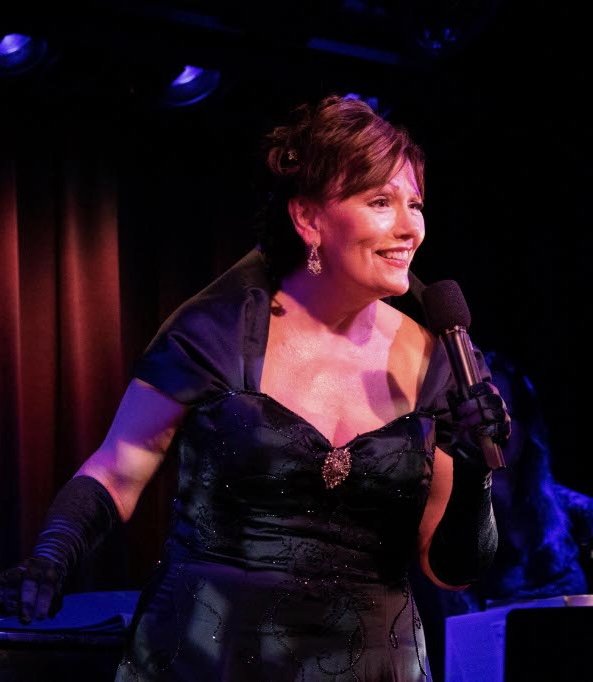
Sixteen years ago, Valerie Lemon had a vivid dream in which, opening a Victorian oak door, she was greeted by a woman in a deep blue gown and opera gloves. The stranger introduced herself as Jane Froman. Who? Lemon Googled Froman, recognizing her from the dream. Research was in order.
Jane Froman (1907-1980) was a popular radio artist who later performed in nightclubs, on Broadway, in films, on television, and recordings. Once asked to name the ten best female singers, impresario Billy Rose replied, “There’s Jane Froman and nine others.”
The vocalist was in a USO plane during WWII when it crashed in Portugal with few survivors. She sustained injuries requiring 39 operations and had to wear a leg brace the rest of her life. Nonetheless, as soon as she was able, Froman resumed her USO tour. In 1952, the release of film biopic With a Song in My Heart starring Susan Hayward reignited her career.
Valerie Lemon felt compelled to create this show. Copious personal research began with the man on whose web site she discovered needed information. He lead her to Barbara Sueling , author of Froman biopic Say It With Music and even communication with Robert Wagner who had a cameo in the film.
An infectiously happy “It’s a Good Day” (Dave Barbour/Peggy Lee) propels the vocalist on stage. Lemon intermittently shares Froman’s biography and anecdotes. Exposition is sympathetic and well placed to create a non-intrusive through line. We even hear a radio commercial of Tom’s Ever Lovin’ Toasty Peanuts. “Hers is a voice I could never hope to imitate, but I can pay tribute to her spirit and courage,” she graciously comments.
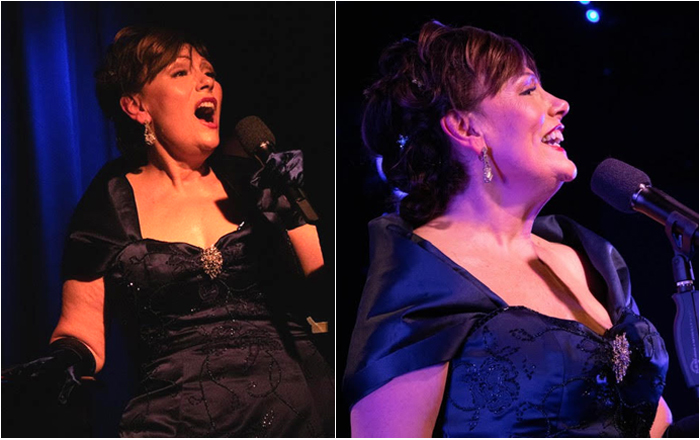
The honoree had a poor, insecure childhood. One day, her father went to the grocery store and never returned. Except in her singing, Froman developed a stutter necessitating Arlene Francis to dub dialogue for many years. A country-club-Latin “Wish You Were Here” (Harold Rome) and lilting “That Old Feeling” (Sammy Fain/Lew Brown) follow. The latter is painful in context, but not over dramatized.
“Somebody Loves Me” (George Gershwin/Ballard MacDonald and BG DeSylva) and “Embraceable You” (George Gershwin/Ira Gershwin) are performed while winding her way through the audience, flirting. You’d have to be a stone not to respond. The artist is warm and genuine. Nothing about this is frivolous.
A beautifully modulated counterpoint of “It Ain’t Necessarily So” and “Summertime” arrives by way of pianist Phil Hall (now vocal as well) and Lemon. Her solo portion wafts dreamy rather than stressed as is often the case (George Gershwin with Ira Gershwin, then Dubose Hayward). “George Gershwin wanted Jane to introduce `Summertime’ over the air. He promised no other artist would be allowed to sing it on the radio for a year. Gershwin kept his promise.”
We hear about Froman’s first marriage falling apart and her USO commitment. “They’re Either Too Young or Too Old” (Arthur Schwartz/ Frank Loesser) represents WW II. Lemon appears palpably frustrated.
Notes on the tragic plane crash precede “I’ll Walk Alone” (Sammy Cahn/ Jule Styne). Piano is minimal, more effective for the choice. The vocalist exudes pride and grace. After the crash, Froman spent time at the Menniger Clinic and addressed her stutter.
An Americana medley was a staple in Froman’s shows for the troops. The theater joins in several familiar, city-centric songs and ends with “America the Beautiful” (Samuel A. Ward/ Katherine Lee Bates). Citing Froman’s second marriage elicits Ira Brant/Hal David’s “Cling To Me,” an unabashed love song. Piano is caressed. (Hall has a wonderfully light, sensitive touch.) This marriage also dissolves.
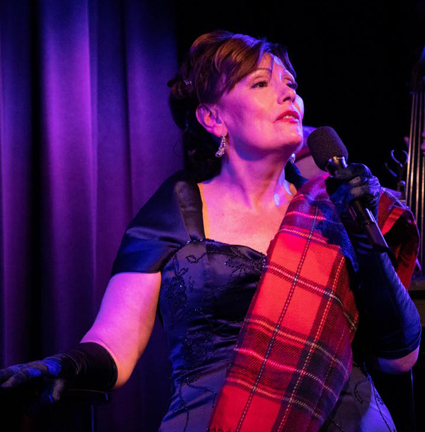
Froman moved back to Missouri where she married an old friend and became a housewife active in social issues. “Goin’ Home” (Antonin Dvorak/ William Anns Fisher) is touching.
At this point in the show, we’re offered what feels like two endings, a reprise of “Get Happy” with reference to a 1959 Persian Room appearance and “I Believe” (Ervin Drake/Irvin Graham/ Jimmy Shirl/Al Stillman), personifying Jane Froman. Choosing one would benefit the piece.
The show is tasteful, engaging and deftly put together. Material is appealing. Valerie Lemon is in excellent voice. A performer who wears her heart on her sleeve, she’s fully invested, making the show extremely empathetic as well as entertaining.
The Jane Froman Songbook is available on CD Baby.
Photos by David Rosen
Valerie Lemon- The Jane Froman Songbook: A Song in My Heart
Christopher Deny-Arrangements
Phil Hall – Piano, Vocal
Mary Ann McSweeny – Bass
The Laurie Beechman Theater in The West Bank Café
By Sandi Durell.
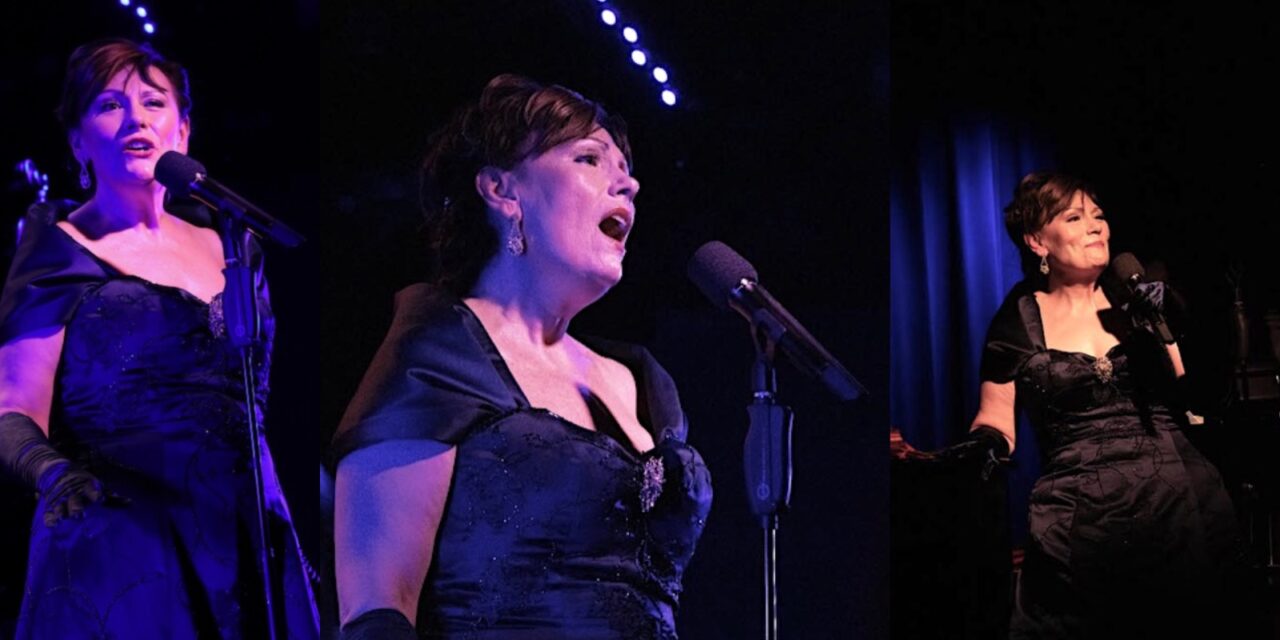
What to do when you’re a singer of note with a lovely soprano voice and one day you are chosen? That’s basically what happened to Valerie Lemon when she was ‘picked’ – in a dream – by Jane Froman – or the spirit and light of Jane Froman – to continue the legacy of the remarkable Ms. Froman (1907-1980).
With time and care, Valerie developed The Jane Froman Songbook – A Song in My Heart which has enthralled audiences throughout the country and again at Lynn University’s Wold Theater on February 12, 2022. The elegant era of 40s and 50s nightclubs comes alive with great sensitivity, not only in song but with vivid memories, stories and photo slides of the intrinsic nature of Jane Froman.
Valerie Lemon, looking tastefully classy in a midnight blue gown accessorized with long opera gloves, provides the grace and silky soft nostalgia of the iconic tunes written by favorite songwriters Gershwin, Rodgers, Hart, Styne, Porter, Loesser and many more that make up the essence of Jane Froman’s illustrious career. She presents a memorable plethora of the American Songbook including “That Old Feeling”, “Summertime”, “Blue Moon”, “Give My Regards to Broadway”, “Begin the Beguine”, “It’s A Most Unusual Day,” I Believe” and the title tune “With a Song in My Heart,” to name a few.
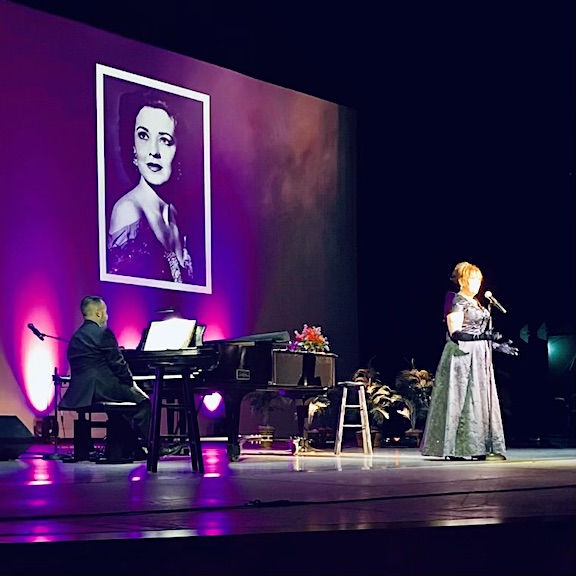
Valerie’s immediate connection to the material is palpable as is her admiration and love of the popular radio, nightclub, film, TV and recording artist Jane Froman. One needs to Google her to understand the inspiration derived relating to this woman, a performer with a unique understanding about human connection with an ability to rise above heartache and pain.
A guest on Valerie’s show was the unstoppable, ever glamorous vocalist, KT Sullivan, also the Artistic Director of the Mabel Mercer Foundation, who came aboard to have a little fun with Valerie and notable musical director of the evening Kenneth Gartman. The three of them showed off some light-hearted dynamics and harmonies with Harold Arlen/Johnny Mercer’s “Accentuate the Positive.”
A beautiful rendition of Ervin Drake, Irvin Graham, Jimmy Shirl and Al Stillman’s “I Believe” brought the evening to a close.
A compelling story in song lovingly presented by Valerie Lemon! (P.S. And Ms. Lemon is a terrific whistler!)
The Jane Froman Songbook is available on Apple Music, YouTube and other digital downloads.
By: Peter Leavy, Cabaret Scenes
“Valerie Lemon arrives on stage looking eerily like Froman, and she’s gifted with a similar supple and lyrical mezzo. Outfitted in a ball gown of lace and tulle, the illusion is remarkable, as is much of the show. Lemon captures the bubbly essence of Froman’s reassuring voice with evergreens like the Gershwin’s "Embraceable You" and plaintive reading of "I believe". "I’ll Walk Alone" gives Lemon her finest moment. The show has potential for a life outside cabaret.”
— John Hoglund, Backstage
“Valerie Lemon has created a veritable time machine. With her sophisticated look, elegant garb, command of the stage and her nostalgic songs, she transports her audience to the heyday of the New York’s ’forties and ’fifties nightclub scene. Offering many of the most memorable numbers from the Jane Froman Songbook (Somebody Loves Me, I’ll Walk Alone, That Old Feeling, Blue Moon), she effectively sweeps the room back to the era of the Empire Room, the Persian Room, La Chansonette, Cafi Society, the nights of shows at 10, 12 and 2, and the heyday of American songwriters. Just glancing at Valerie’s song list starts a cabaret aficionado’s blood surging. The tunes of Harold Arlen, Richard Rodgers, Arthur Schwartz, George Gershwin and Sammy Cahn, lyrics by Lorenz Hart, Buddy DeSylva, Peggy Lee, Jule Styne, Frank Loesser and others.
With the aid of her accompanist, Don Rebic, arrangements by Christopher Denny and Phil Hall, and Eric Michael Gillett as director and co-writer of the script - it was more than just patter - Valerie Lemon’s show is a touching overview of Froman’s life, a reminder of her importance to the popular music scene for a score of years, and a perfect showcase for Valerie’s honey-sweet voice. Chalk up this one as a ‘don’t miss.’”
By: William Wolf
Host KT Sullivan and executive producer Steve Downey are on to something worthwhile. At the Carnegie Weill Recital Hall they unveiled what could turn out to be an appealing annual event. The idea: Have a centennial celebration of songwriters and singers born in the designated year. The initial program premiered in style, with a strong array of performers delivering a succession of winsome numbers and the evening hosted congenially by Ms. Sullivan.
To give you an idea of how it works, Cab Callaway was born in 1907. Hence, smooth Allan Harris was on hand to deliver a rousing “Minnie the Moocher,” Callaway style, with the audience chiming in without even being asked. Gene Autry, the singing cowboy of records and music was born that year, which provided the occasion for Tim Sullivan (KT’s brother) to turn up with the western-slanted musical backup group The Sons of the Pioneers (Gary Cook, Matt Palmer, Joel Racheff) to sing “Red River Valley” and other Autry hits.
The most daring expedition of the evening was Olivia Stevens’s performing of songs made known by Swedish signer Zara Leander, who during the Nazi regime in Germany snuggled up to the Nazi bigwigs, with her songs broadcast to Allied troops. As a woman of Jewish origins, Stevens nevertheless has the nerve to explore and imitate the one-time star, born in 1907, and with her sultry voice, she puts on an impressive show.
The World War II war years from the U.S. perspective were reflected by the appealing Valerie Lemon in an ode to Jane Froman, who was severely injured in a plane crash while traveling to entertain troops. She was joined by a quartet dubbed “The Jane Froman Singers.”
Naturally, KT got into the act, recalling memories of Kate Smith (also 1907) and singing her theme song “When the Moon Comes Over the Mountain,” and also another one that became a Smith hit, “We’ll Meet Again.”
Among the 1907 brigade remembered were also Alec Wilder, Connee Boswell and Paul Francis Webster. Artists joining in the 1907 salute with their appealing performances included Karen Kohler, Nancy McGraw and Craig Rubino, all contributing importantly to the theme. The musicians providing backup included Jon Weber on piano, Guus Wesdorp on piano, Steve Doyle on bass and the clarinet duo of Peter and Will Anderson. The event was directed by Eric Michael Gillett, who also performed powerfully (Edward Heyman’s “When I Fall in Love”) and made much of KT being one of his first friends in show business. Ted Firth was musical director.
The premiere of the idea showed considerable class, and the stage was set for a succession of such centennials, assuming there is audience support. The years are there waiting. The only question is how long will we all live? Reviewed at Carnegie Hall’s Weill Recital Hall.
By: Gloria Taplin
Cute and cocky, yet sophisticatedly stylish in her tailor-made, maroon and black cutaway tuxedo, Valerie Lemon took the stage of the Metropolitan Room, and confidently, energetically began her new act, Music by Marvin Hamlisch, singing “Welcome to the Night.” She immediately both conveyed an understanding of why Sweet Smell of Success was such a Broadway success for composer Hamlisch, and found a wonderful way of greeting her audience. Looking at each and every part of the room with a wide, vibrant smile directed, it seemed, at each person in it, she and her lovely, versatile voice could not have been more welcoming.
Her patter was more interesting than most. At intervals between songs, she gradually told the story of her relationship with Marvin Hamlish. One piece of the story told of how she went from being one of three vocalists traveling with Hamlisch on the road, to a day when she was called in virtually at the last moment to do the show with Hamilsh solo. Hamlisch reassured her by spreading out all the music on the piano, but with a pixie-ish smile on her face, she enjoyed being able to say she never had to look at it. That’s how, she recalled, she became Hamlisch’s vocalist for twelve years.
The feeling way she sang “The Way We Were” brought out, among other things, Lemon’s talent for doing the lyrics justice. “Memories” is the first and most important word in the song, and Lemon did a perfect job of stressing it. That talent seems to be part of her sensitivity to lyrics, their phrasing and meaningful interpretation.
Although Lemon seemed to be tiring as she ended the show and her movements began to seem somewhat mechanical, she still produced wonderfully moving, vital, humorous, interesting music. Beautiful vocalizations, great interpretations, and continued attempts to reach out to the audience. And with loud enthusiastic applause, the audience responded appreciatively.
Lemon could not have been more generous to those who contributed to her act, both seen and unseen. After her first song, she introduced her very visible Musical Director and piano accompanist Don Rebic, drummer Charlie Descarfino, and bassist Jared Egan. Though Director, Eric Michael Gillett, may have been unseen, he was not unacknowledged as a very talented, constructive asset to Lemon’s act.